You open a sports betting site for the first time and you see three options: single, accumulator, system. These three formats coexist on almost every platform, but they work in completely different ways. Picking the wrong one for the wrong reason is one of the most costly mistakes a beginner can make. This guide explains everything clearly.
The Single Bet: The Foundation of Everything
A single bet means staking on one outcome only. It is the most direct and transparent form of sports betting.
- How it works: you pick one event (for example, a team to win), stake an amount, and wait for the result.
- Return:
stake × odds— simple and clear. - Risk: limited to the single stake on that one bet.
Example: you stake €20 on a team to win at 2.50. If you win: 20 × 2.50 = €50 (profit of +€30). If you lose: you lose €20, full stop.
This is the bet type recommended for beginners and for bettors seeking long-term value. Variance is lower, results are easier to analyse, and you can track the performance of each bet individually.
The Accumulator: Odds Multiply, So Does the Risk
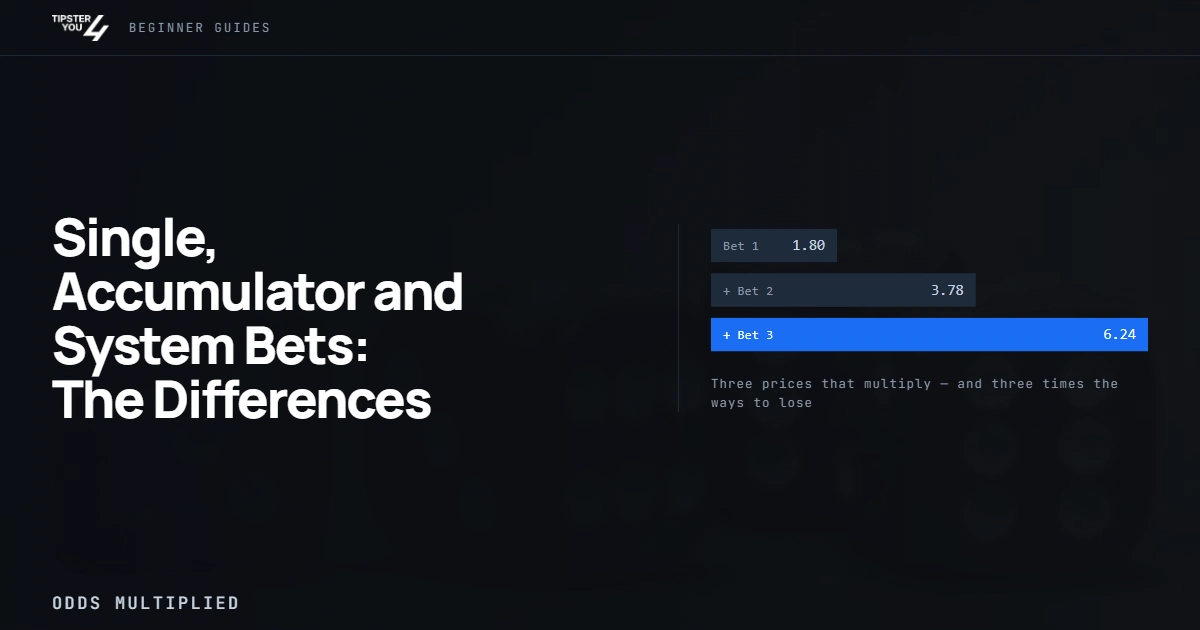
An accumulator (or "acca") combines multiple selections into one single bet. The odds multiply together, which can produce very large returns from a small stake. But the downside is brutal: just one losing selection means the entire accumulator is lost.
How Is the Calculation Done?
The combined odds = the product of all individual odds.
Concrete example — a 3-match accumulator:
| Match | Selection | Odds |
|---|---|---|
| Match 1 | Team A wins | 1.50 |
| Match 2 | Team B wins | 1.80 |
| Match 3 | Team C wins | 2.00 |
| 3-leg accumulator | All 3 win | 5.40 |
Calculation: 1.50 × 1.80 × 2.00 = 5.40
€10 stake on this accumulator:
- If all 3 teams win:
10 × 5.40 = **€54**(profit of +€44) - If just one team loses: full loss of the €10 stake
This is where accumulators become a trap for beginners. Each selection carries a probability of failure. With 3 selections each having a 67 % chance of winning, the probability that all 3 win simultaneously is only 0.67 × 0.67 × 0.67 ≈ 30 %. In other words, on 10 similar accumulators, you lose the €10 in roughly 7 cases out of 10.
Why Beginners Overuse Accumulators
Bookmakers love accumulators for a simple reason: their margin applies to each individual set of odds, so the more selections you add, the more the total margin compounds exponentially. A 5-selection accumulator may display a tempting combined price of 20.00, but the "fair" price without margin might be 30.00.
Beginners are drawn in by the promise of large returns from a small stake. But this approach looks more like a lottery than a strategy. For disciplined betting, placing singles on value selections remains far superior in the long run.
The System Bet: The Smart Compromise
A system bet is a hybrid format. It lets you spread your selections across multiple partial combinations, so you can still win even if one or more selections lose.
Example: the 2/3 System
You choose 3 selections and play every combination of 2 from those 3. This gives 3 two-leg doubles.
| Combination | Included selections |
|---|---|
| Double 1 | Selection A + Selection B |
| Double 2 | Selection A + Selection C |
| Double 3 | Selection B + Selection C |
You stake, for example, 3 × €5 = €15 in total (€5 per double).
- If all 3 win: you win all 3 doubles → maximum return.
- If 2 out of 3 win: you win 1 double out of 3 → partial return, often recovering your stake or more.
- If 1 out of 3 or fewer win: you lose all 3 doubles → full loss.
The 2/3 system is one of the most popular, but others exist: 2/4, 3/4 (Trixie, Patent, Heinz in UK terminology).
Comparison Table of the Three Bet Types
| Bet type | Potential return | Risk | Best for |
|---|---|---|---|
| Single | Moderate (odds × stake) | Limited to 1 bet | All levels, long-term strategy |
| Accumulator | Very high (odds multiplied) | Total loss if 1 leg fails | Use sparingly |
| System | Intermediate | Partial (reduced losses) | Intermediate bettors |
Worked Example: Accumulator vs Singles, Same Budget
Budget: €30, 3 selections each at 1.80.
Option A — 3 singles of €10 each:
| Result | Return if win | Return if loss |
|---|---|---|
Bet 1 (€10 at 1.80) | +€8 | −€10 |
Bet 2 (€10 at 1.80) | +€8 | −€10 |
Bet 3 (€10 at 1.80) | +€8 | −€10 |
If 2 out of 3 selections win: +8 + 8 − 10 = +€6 net profit.
Option B — 1 accumulator of €30 on all 3 selections (combined odds: 1.80 × 1.80 × 1.80 = 5.83):
- If all 3 win:
30 × 5.83 = €174.90(profit of +€144.90) - If 2 out of 3 win: full loss of €30
The accumulator offers a tempting jackpot, but the probability of losing is far higher. Over the long term, single value bets are always more profitable.
Checklist Before Choosing Your Bet Type
- I understand that in an accumulator, one loss = everything lost
- I favour singles to build a bankroll over the long term
- If I use an accumulator, I limit it to 2–3 selections maximum with a reduced stake
- I know the individual odds of each selection before combining them
- For a system bet, I have checked the total cost (number of combinations × unit stake)
All three formats have their place in sports betting, as long as you know which one matches your goal. The single bet remains the best tool for improving and genuinely measuring your performance. Sports betting carries risk — gamble responsibly, and only stake what you can afford to lose (18+).
Follow the tipsters who communicate transparently with single bets and a verified track record on the tipster ranking.