A tipster is someone who analyses sporting events and shares their predictions with other bettors. The word comes from tip (advice). Their job: spot value bets — where the offered odds are higher than the real risk — and let their community benefit. But not all tipsters are equal. Here's how to understand them and pick a good one.
What does a tipster actually do?
A good tipster doesn't "guess" — they work. Their day looks like this:
- Analysing matches: team form, injuries, history, statistics, context.
- Comparing odds across bookmakers to spot value (odds that are too high).
- Publishing a clear prediction: the event, the bet, the odds and the recommended stake.
- Tracking results over time with a transparent history.
It's consistent analytical work, not a one-off stroke of luck.
How does a tipster make money?
There are two revenue sources, often combined:
- Their own bets — if they find value, they win long-term with their bankroll.
- Selling their predictions — monthly subscriptions or one-off tips, for bettors who'd rather follow the analysis than do it themselves.
On a platform like Tipster4You, the tipster sets their prices and earns a commission on each sale, with public statistics that prove (or disprove) their performance.
The metrics that actually matter
The beginner trap: looking at the hit rate (% of bets won). On its own it means almost nothing. What matters is ROI (return on investment), also called yield:
ROI (%) = (net profit ÷ total staked) × 100
Let's compare two tipsters over 100 bets:
| Tipster | Hit rate | Average odds | ROI | Verdict |
|---|---|---|---|---|
| A | 70 % | 1.30 | −9 % | Loses money despite a 70 % hit rate |
| B | 40 % | 2.80 | +12 % | Wins, by betting on value |
Tipster A wins often but on short odds → loses in the end. Tipster B loses more often but their value bets make them profitable. ROI tells the truth, not the hit rate.
How to recognise a GOOD tipster
- A verified, public history: every tip timestamped, with the odds at the time.
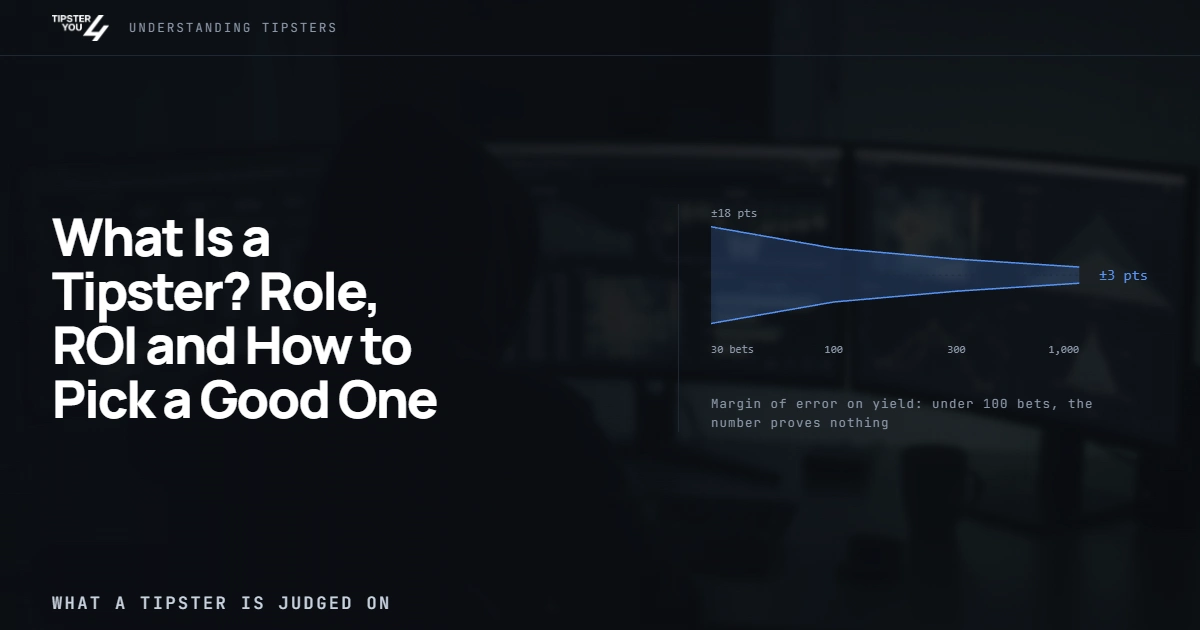
- Consistency: a stable ROI over hundreds of bets, not 10 lucky shots.
- Clear bankroll management: stakes in units, never "all on one match".
- Transparency about losses: an honest tipster shows their losing runs too.
- Explanations: they justify their picks, not just drop a bet.
Red flags (run away)
- "Guaranteed profit" or "100 % sure" — that doesn't exist in sports betting.
- No history, or a history that "starts" with each new ad.
- Screenshots of winnings with no proof of stake or long-term tracking.
- Unrealistic odds ("fixed match", "inside info").
- Buying pressure ("last spots", "offer expires in 1h").
Tipster vs casual bettor
A casual bettor bets on instinct, on their favourite team, with no tracking. A professional tipster treats it like an investment: an analysis process, staking discipline, ROI measurement, risk management. The difference isn't luck — it's method.
Checklist to pick your tipster
- Their ROI is positive over several hundred bets.
- Their history is public, timestamped and verifiable.
- They state the recommended stake and manage a bankroll.
- They never promise guaranteed winnings.
- They're consistent, not a flash in the pan.
So a tipster isn't a fortune-teller: they're a disciplined analyst whose value is measured by ROI, not by promises. Learn to read these metrics and you'll dodge 90 % of the scams.
On Tipster4You, every tipster has transparent statistics and a verified history: ROI, hit rate, number of bets, current streaks. Compare them on the tipster ranking and subscribe to those who prove their worth.