
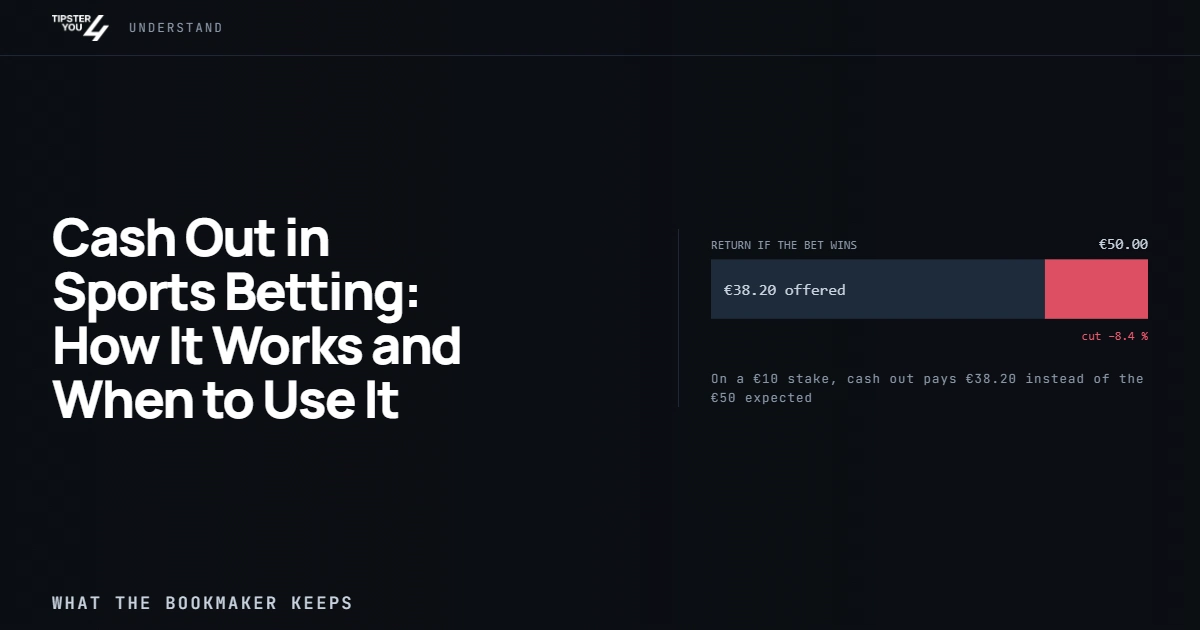
Cash out is one of the most used — and most misunderstood — features on sports betting sites. The button is tempting: it offers to hand you money right now, before the match is even over. But behind that offer sits a precise calculation, an extra margin and, very often, a decision made under emotion. This guide explains how the amount is calculated, when cash out is a genuinely useful tool, and when it simply costs you money.
What Exactly Is Cash Out?
Cash out lets you close a bet before the event has finished. The bookmaker offers you a fixed amount: if you accept, your bet is settled immediately, whatever the final result.
Three scenarios:
- Your bet is going well → cash out offers a smaller payout than the potential win, but a guaranteed one.
- Your bet is going badly → cash out offers to return part of your stake rather than losing it all.
- Partial cash out: you take a fraction of the bet and let the rest ride.
The offered amount moves in real time with the live odds. It can be suspended for a few seconds after a major event (goal, red card, penalty).
How the Cash Out Amount Is Calculated
The principle is simple: the bookmaker estimates what your bet is worth right now, based on the current live odds of your selection. Then it takes its margin off the top.
The simplified formula for the theoretical value:
current value = stake × opening odds ÷ current live odds
Then:
cash out offered = current value − bookmaker margin
The closer your selection gets to winning, the lower the live odds drop and the higher the current value climbs towards your potential payout. Conversely, if your selection drifts away from winning, the live odds rise and the value melts away.
Worked Example: A €20 Stake at 3.00
You staked €20 on Team A to win at pre-match odds of 3.00. Potential return: €60 (€40 net
profit).
In the 70th minute, Team A leads 1-0. Their live odds to win the match have dropped to 1.40.
- Theoretical value of your bet:
20 × 3.00 ÷ 1.40 = €42.86 - Cash out offered by the bookmaker: ≈ €38
The gap between €42.86 and €38 is the bookmaker's margin on the operation — here roughly 11%. You already paid a margin when you placed the bet; by cashing out you pay a second one. That is why systematic cash out loses money over time.
Table: Hold, Full Cash Out or Partial Cash Out?
Using the example above (€20 stake at 3.00, full cash out offered €38, 50% partial cash out
offered €19), here is how the three options compare depending on the final result:
| Option | If Team A wins | If Team A does not win | Guaranteed result? |
|---|---|---|---|
| Hold the bet | +€40 | −€20 | No |
| Full cash out (€38) | +€18 | +€18 | Yes |
| 50% partial cash out (€19) | +€29 (19 + 30 − 20) | −€1 (19 − 20) | Partially |
Partial cash out is often the best compromise: you (almost) secure your stake while keeping exposure to the win. But remember: every euro taken via cash out pays the margin.
When Cash Out Makes Sense
There are situations where accepting a reduced value is a rational choice:
1. Securing an accumulator with one leg remaining. You have a 5-leg accumulator, 4 legs have won and the last is in play. If the potential payout is a significant share of your bankroll, taking part of it (partial cash out) reduces variance. To understand why accumulators amplify risk, re-read single, accumulator and system bets.
2. New information changes the analysis. A key player injured, a red card, worsening weather: if the event changes your probability estimate (and not just your stress level), the bet no longer holds the value you originally gave it.
3. Your bankroll is at risk. If a loss would push you outside your unit rule (1–3% of bankroll per bet), you sized the stake wrong — but cash out can limit the damage on that occasion. Fix your staking afterwards.
When Cash Out Costs You Money
Systematic cash out. If you cash out every time your bet goes ahead, you pay the bookmaker's margin twice on every bet. Across 100 bets, that is a huge drain on your return.
Emotional cash out. A goal conceded in the 75th minute, the fear of losing everything, and you click. If your original analysis was sound, nothing has changed in the true probability: only your feelings have moved.
Cash out to "salvage something". When your bet is going very badly, the offer is tiny (a few euros). Your stake is already nearly lost; recovering 10% of it after margin rarely adds value.
Cash Out and Expected Value
If you picked your bet for its value (odds higher than the true probability), then cashing out means swapping a positive-EV bet for an amount with EV reduced by the margin. Mathematically, you are moving away from the approach that wins over the long term.
The only exception: when the situation has genuinely changed and your probability estimate has flipped. In that case the bet no longer has positive EV in your eyes, and getting out may be the right call. To revisit expected value, see our guide on value betting.
The Most Common Mistakes
1. Believing cash out is "free". It always embeds a margin — that is how the bookmaker earns money on the feature. To understand the mechanics, read how a bookmaker works.
2. Never calculating the theoretical value.
Before accepting, compare the offer with stake × opening odds ÷ live odds. If the gap exceeds
10–15%, the price is poor.
3. Using cash out as your main strategy. Cash out is an occasional risk-management tool, not a winning method.
4. Forgetting partial cash out. It is often a better fit than the all-or-nothing of a full cash out.
Checklist Before Accepting a Cash Out
- I calculated the theoretical value (
stake × opening odds ÷ live odds). - The gap with the offered amount is reasonable (margin < 15%).
- New information has genuinely changed my estimated probability (not just my stress).
- I considered a partial cash out rather than a full one.
- My decision is not about "chasing" a loss or calming an emotion.
- The payout at stake is a significant share of my bankroll (otherwise, hold the bet).
Used well, cash out is an occasional insurance policy. Used badly, it is a tax you volunteer to pay on every bet. Set yourself clear rules in advance, before kick-off, and stick to them.
Sports betting carries risk: only bet money you can afford to lose.
Find tipsters who publish their picks with verified track records on the tipster ranking — filter by sport, bankroll and return.


