Live betting (also called in-play betting) means placing bets while the match is being played. Odds are recalculated after every action, markets open and close within seconds, and the adrenaline is very real. It is both the most exciting and the most dangerous playground for a bettor. This guide explains how it works, why the odds move, and above all how to find value in-play without getting carried away.
What Is Live Betting?
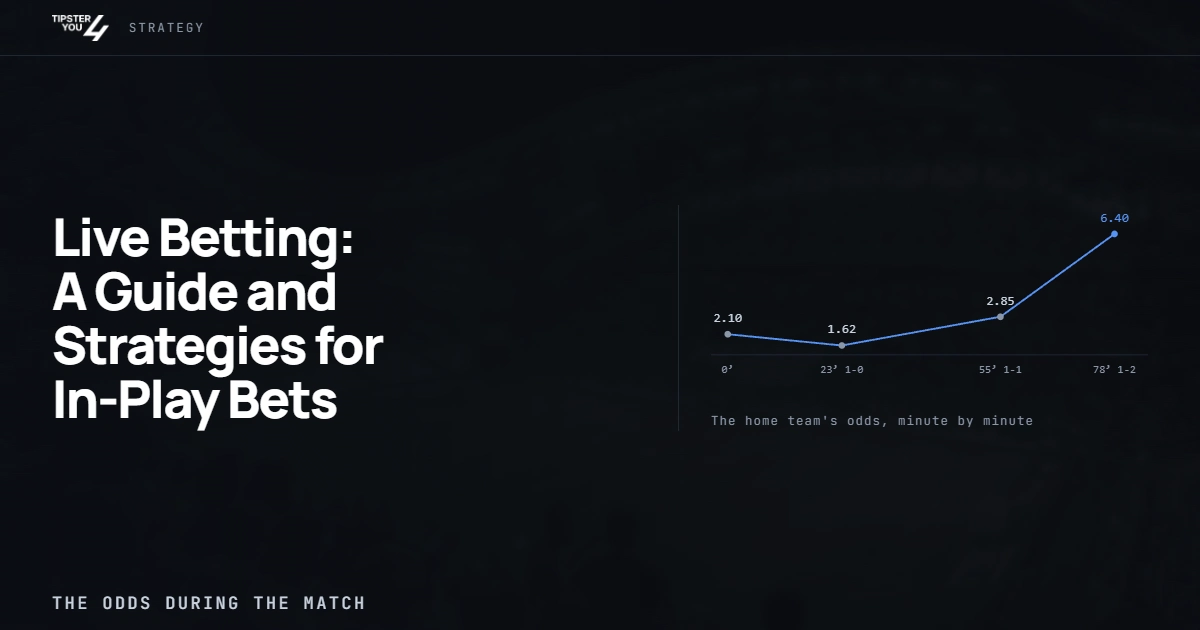
Pre-match, you analyse, you bet, then you wait for the final whistle. In-play, everything happens in real time: you can bet in the 12th minute, at half-time, after a red card or two minutes from the end. The bookmaker continuously recalculates its odds from the score, the time remaining and the events of the match.
Three major differences from pre-match betting:
- Odds move constantly. A price can double or halve in under a minute after a goal.
- Markets are suspended on every significant action (goal, penalty, card, VAR review). For a few seconds, betting is impossible: the bookmaker is protecting itself.
- There is an acceptance delay: between your click and the bet being confirmed, the bookmaker usually waits 5 to 10 seconds. If the odds change in the meantime, your bet may be rejected or accepted at the new price.
The Main In-Play Markets
Live betting carries over most pre-match markets, adjusted for score and time, and adds a set of short-term markets of its own:
| Market | Description | Example |
|---|---|---|
| Match winner (live 1X2) | Final result, odds recalculated from the current score | Team A leads 1-0 → A at 1.30 |
| Next goal | Which team scores next (or no more goals) | Next goal: Team B at 2.40 |
| Adjusted Over/Under | Total goals, with a line that drops as the match goes on | Over 2.5 in the 60th minute at 1-1 |
| Correct score | Exact final score, highly volatile in-play | 2-1 at 6.50 |
| Live handicap | Virtual advantage/disadvantage applied from now on | Team A -1 on the rest of the match |
| Short markets | Events within a narrow window (next corner, goal before the 75th) | Goal before 75' : yes at 1.90 |
Short markets are the most tempting — and the most treacherous. They multiply the chances to bet, and therefore the chances to be wrong. Start with the match winner, next goal and over/under: these are the ones you can evaluate best.
Why Odds Move (and What That Tells You)
The bookmaker does not follow the match "by eye". It uses a probability model that starts from the pre-match price and updates it on three variables:
- The current score: the main driver. A goal changes everything.
- Time remaining: the more time is left, the more likely a comeback, so the more the odds stay open. Five minutes from the end, prices almost freeze.
- Events: red card, injury to a key player, penalty awarded, tactical change.
The key thing to understand: the model is reactive, not omniscient. It incorporates what has happened, not necessarily what is happening. A team dominating without scoring keeps a high price as long as the score does not change. That is where your eyes can make the difference.
If you already master the basics of reading a price — implied probability, margin — live betting becomes far more readable. If not, start with our guide on how to read betting odds.
Worked Example: The Favourite Trailing 0-1 in the 25th Minute
Take a match where Team A is the pre-match favourite at 1.60 (implied probability: 100 ÷ 1.60 = 62.5%). In the 25th minute, Team B opens the scoring with its first real chance. Team A's price
jumps to 3.20 (implied probability: 31.3%).
The model reacted to the score. But you are watching the match:
- Team A has 68% possession and 7 shots to 2.
- Team B's goal came from an isolated counter-attack, with no sustained pressure behind it.
- There are 65 minutes left plus stoppage time.
- No cards, no injuries, Team A's full starting eleven is still on the pitch.
Your own estimate: Team A still has roughly a 45% chance of winning (it needs to score twice, but it has plenty of time and the run of play). Expected value calculation:
EV = (0.45 × 3.20) − 1 = 1.44 − 1 = +0.44
An EV of +0.44 is very high. That does not mean Team A will win — you will lose more than half of
these bets — but the price is excellent relative to the real risk. This is exactly what our
article on value betting describes, applied in-play.
Conversely, if Team B had been dominating and the goal was deserved, 3.20 would be a fair price —
and you would pass.
5 Concrete Strategies for Live Betting
1. Watch the match — actually watch it. Betting in-play without seeing the match, just from the score and a stats panel, is playing blind against a model that has the same data as you. Your only edge is your eyes: momentum, fatigue, players' body language. Without pictures, stay pre-match.
2. Bet on momentum, not on the score. The score is already priced in. What is not (yet) priced in is what you observe: a team pushing forward, a defensive block dropping deeper, a goalkeeper saving everything. Value lives in the gap between the pictures and the scoreboard.
3. Target overreactions. After a goal or a red card, the model swings fast and sometimes too far. A favourite down to ten men is not doomed in the 30th minute. An underdog that scores early has not "won". Exaggerated prices right after an event are often the best opportunities of the whole match.
4. Over/Under after an early goal. A goal in the first 10 minutes sends the Over price tumbling. But a match that opens up early often stays open: the trailing team has to come out, spaces appear. Compare the new line with your estimate of the match's tempo rather than with your gut feeling.
5. Never chase a loss. This is the rule that saves bankrolls. A lost live bet calls for a second bet "to get it back", then a third. Decide before kick-off on your maximum number of live bets (1 or 2) and the stake per bet. Then stick to that limit, whatever happens.
The Traps of Live Betting
Stream delay. Your TV or streaming feed usually runs 30 to 60 seconds behind the pitch. The bookmaker, meanwhile, receives data almost in real time. If you see a clear chance on screen, the market is probably already suspended. Never try to "beat" the book on an event you have just seen — you will always arrive after it.
Emotional decisions. Adrenaline is the enemy of calculation. A bet placed out of frustration or euphoria is not a value bet: it is an impulse with a price attached.
Multiplying bets. A 90-minute match offers dozens of chances to bet. The more you bet, the more the bookmaker's margin accumulates against you. Volume is not a strategy.
Compulsive cash out. In-play cash out is marketed as a safety net. In reality, it is priced with an extra margin. Using it systematically out of fear means paying the bookmaker twice.
All these mistakes have one thing in common: they blow up your staking plan. Re-read our guide on bankroll management before you go live — unit rules are even more vital in-play than pre-match.
Live Betting Checklist
- I am watching the match live (not just following the score).
- I set my maximum number of live bets and my stake before kick-off.
- I bet on what I observe (momentum, fatigue, intensity), not on the score alone.
- I estimated my own probability and calculated the EV before clicking.
- I do not bet right after seeing an action: the market is already suspended or adjusted.
- I do not bet to recover a loss.
- My stake respects my unit rule (1–3% of my bankroll).
Live betting rewards patient, prepared bettors who can ignore the emotion of the moment. If you feel that in-play betting pushes you to bet faster, more often and bigger than planned, take it as a signal: go back to pre-match, or take a break — betting should remain a controlled pleasure.
Want to see how the best handle live betting? Check the tipster ranking — verified track records, transparent ROI, filters by sport and style.