Bankroll management is the most underrated skill in sports betting. You can have the sharpest analysis in the world — if you stake recklessly, you will end up broke. Understanding how to manage your capital is the difference between lasting years and blowing up in a few weeks. This guide covers everything: definitions, methods, and traps — all with concrete numbers.
What Is a Bankroll?
A bankroll is the capital you set aside exclusively for sports betting. It is not your overall bank account, nor "available money this month." It is a defined sum decided upfront, one you are prepared to lose entirely without it affecting your daily life.
The ground rules:
- It is separate from your savings and living expenses.
- You set it once at the start (you can top it up later, but never to "chase" losses).
- It must never represent borrowed money or money you need.
Sports betting carries a risk of financial loss. Only bet with money you can afford to lose. 18+.
The Unit: Your Standard of Measure
When managing a bankroll, we do not think in raw euros but in units. One unit (U) is a fixed percentage of your total starting bankroll. Using units allows you to:
- Standardise stakes regardless of your bankroll size.
- Compare performance across bettors (a tipster at +45 U is a universal metric).
- Absorb swings: when your bankroll shrinks, your stake in euros shrinks with it.
The conservative rule: 1 unit = 1 to 2 % of your starting bankroll. Up to 3 % for experienced bettors with high conviction.
The Three Main Staking Methods
There are several strategies for calculating how much to bet on each pick. Here are the three most common, compared side by side:
| Method | Principle | Advantages | Disadvantages |
|---|---|---|---|
| Flat staking | Always the same amount (e.g. €10) regardless of odds | Simple, disciplined, low variance | Does not adapt to value or odds |
| Proportional staking | X % of current bankroll each bet | Automatically adjusts to ups and downs | Slightly more complex; slow growth |
| Kelly Criterion | stake = bankroll × (p × (odds−1) − (1−p)) ÷ (odds−1) | Maximises long-term growth | Requires accurate probability estimate; volatile |
For beginners, flat betting is the healthiest approach: you always stake 1 unit, regardless of confidence level or odds. Simple and powerful.
Worked Example: €1,000 Bankroll, 1 % per Bet
Imagine you start with a €1,000 bankroll. You set your unit at 1 % = €10.
Here is the impact of 5 consecutive losses with flat staking versus proportional staking:
| Bet | Flat stake (€10) | Flat bankroll | Proportional stake (1 %) | Proportional bankroll |
|---|---|---|---|---|
| Start | — | €1,000 | — | €1,000 |
| Loss 1 | €10 | €990 | €10.00 | €990.00 |
| Loss 2 | €10 | €980 | €9.90 | €980.10 |
| Loss 3 | €10 | €970 | €9.80 | €970.30 |
| Loss 4 | €10 | €960 | €9.70 | €960.60 |
| Loss 5 | €10 | €950 | €9.61 | €950.99 |
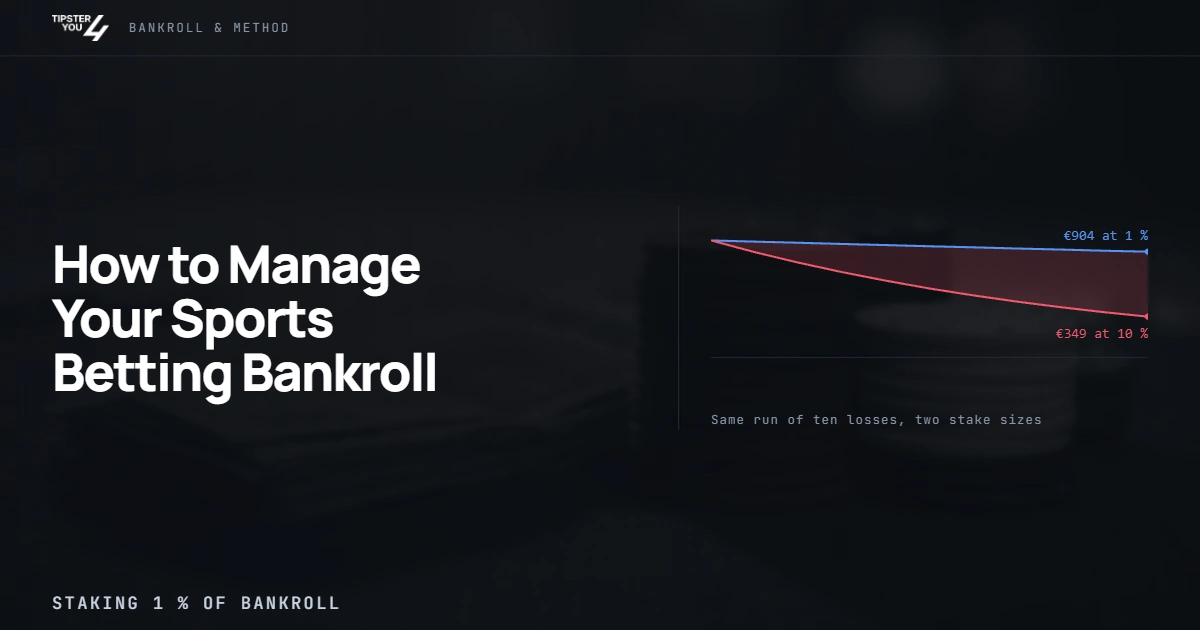
After 5 losses you are down just €50 with flat staking — only 5 % of your bankroll. Plenty of capital left to recover.
Now imagine you had been staking €100 per bet (10 %): you would have lost €500 — half your bankroll — from a single bad run. That kind of run happens to every bettor.
The Martingale Trap
The martingale is the most dangerous strategy out there: you double your stake after every loss to "win it back." Example:
- Bet 1: stake €10, lost → −€10
- Bet 2: stake €20, lost → −€30
- Bet 3: stake €40, lost → −€70
- Bet 4: stake €80, lost → −€150
- Bet 5: stake €160, lost → −€310
In 5 consecutive losses (a single rough weekend), your stake explodes to €160 and the total
loss hits €310. On a €1,000 bankroll, that is 31 % wiped out. And bookmakers impose stake
limits that will stop the strategy before you can ever recover.
The martingale only works if you have infinite funds. You do not.
Adjusting Stakes to Confidence (Without Derailing)
Some bettors use a confidence scale: 1 U for a standard pick, 2 U for strong conviction, 3 U for an elite signal. This is acceptable as long as you:
- Never exceed 3 % per bet.
- Stay objective (do not inflate confidence after a winning streak).
- Record your forecasts to verify retrospectively whether your confidence was justified.
To go further on assessing whether a bet is worth placing, read our guide on value betting — the essential prerequisite for effective bankroll management over time.
Bankroll Management Checklist
- My bankroll is separate from my everyday money and I can afford to lose all of it.
- I have set my unit at 1–2 % of my starting bankroll.
- I always stake the same unit (or a 1/2/3 U scale maximum) without exception.
- I do not use the martingale or any stake-doubling method.
- I keep a log of every bet (stake, odds, result, P&L).
- I reassess my bankroll (and my unit in €) only at the start of each month.
Bankroll management does not guarantee you will win — nothing does. But it guarantees you will survive losing runs and still be in the game when things turn around. That is the whole point.
Discover tipsters who combine solid bankroll management with proven value betting on the tipster ranking — all staking histories are independently verified.