Having a positive ROI in sports betting is the real performance indicator — not the number of winning bets, not the biggest odds you landed. Yet most bettors do not know how to calculate their return correctly. This guide gives you the exact formulas, worked examples, and explains how many bets you need before drawing any meaningful conclusions.
Definitions: ROI, Yield, and Gross Profit
Three metrics are often confused. Here is the clear distinction:
- Gross profit: total winnings minus total stakes. Simple, but incomplete because it ignores the capital at risk.
- ROI (Return on Investment): the return on total capital invested from the start. Used to assess the overall performance of a strategy or portfolio.
- Yield: the return per bet, measured against the total amount staked across all bets. This is the most widely used metric for comparing tipsters.
In sports betting practice, ROI and yield are calculated the same way — the terminology varies by country and platform. Here is the unified formula:
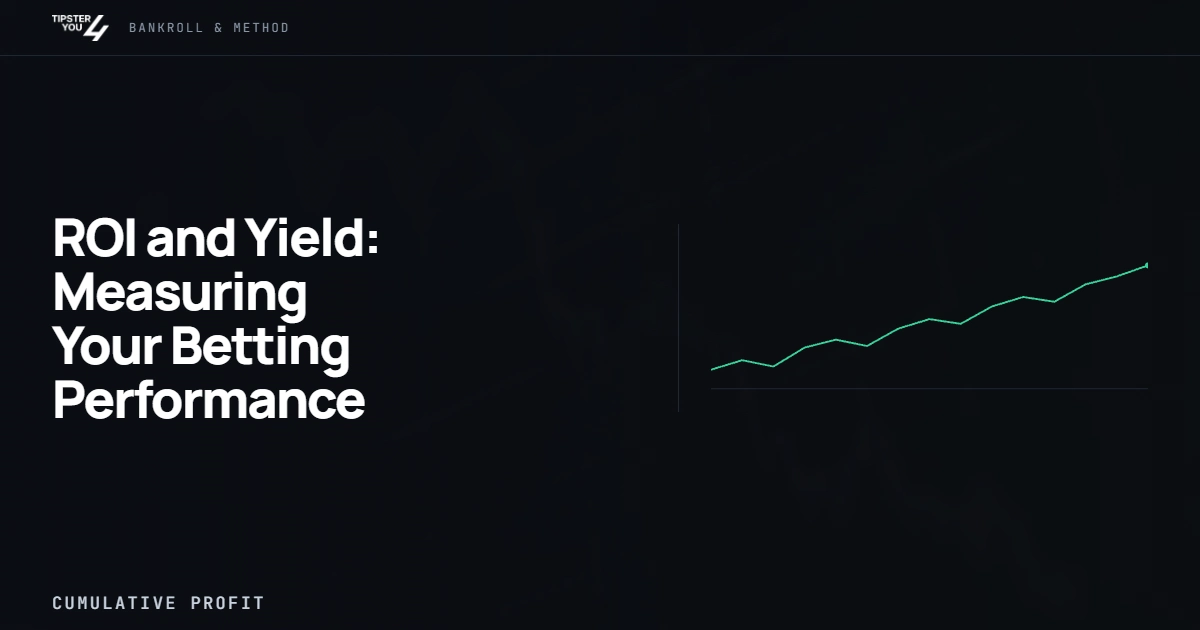
ROI / Yield (%) = (net profit ÷ total staked) × 100
- Net profit = total returns (stakes returned + winnings) − total staked
- Total staked = sum of all stakes placed
The Formula in Detail
Let us use a simple illustrative example to make the formula concrete.
Imagine that over 50 bets, you staked a total of €500 (€10 average per bet) and received back €560 in total (cumulative returns on winning bets).
net profit = €560 − €500 = €60
yield = (60 ÷ 500) × 100 = **+12 %**
A yield of +12 % is excellent — very few professional bettors sustain above +10 % over a large volume. A yield between +3 % and +7 % is already considered solid.
Profit vs ROI: Why Gross Profit Is Misleading
Here is why sticking to gross profit gives a false picture:
- Bettor A makes €200 profit having staked €400 → yield +50 % (but only 10 bets).
- Bettor B makes €200 profit having staked €10,000 → yield +2 % (over 500 bets).
Same gross profit, radically different performance. Bettor A may have simply been lucky; Bettor B likely has a genuine edge.
Yield/ROI weights the gain against the capital risked and gives an honest picture of profitability.
Comparison Table: Two Bettors, Same Apparent Win Rate
| Metric | Bettor A | Bettor B |
|---|---|---|
| Number of bets | 200 | 200 |
| Win rate | 60 % | 45 % |
| Average odds | 1.40 | 2.50 |
| Total staked (€10/bet) | €2,000 | €2,000 |
| Total returns | €1,680 | €2,250 |
| Net profit | −€320 | +€250 |
| Yield | −16 % | +12.5 % |
Bettor A wins 60 % of bets — impressive at first glance — but at such short odds (1.40
average) that ROI is negative. Bettor B wins only 45 % of bets but at higher odds, and
their yield is strongly positive.
Remember this: win rate alone tells you nothing. Everything depends on the average odds played.
The Small Sample Size Trap
This is the most commonly overlooked point: how many bets do you need before drawing conclusions?
Variance in sports betting is enormous. Over 50 bets, even a random bettor can show a +15 % yield purely by luck. Over 500 bets, luck evens out and results converge toward the true value.
Widely accepted rules of thumb:
- < 100 bets: no reliable conclusion. Variance dominates everything.
- 100–300 bets: a trend is visible, but with wide confidence intervals.
- 300–500 bets: results start to be statistically meaningful.
- > 500 bets: a positive yield becomes a genuine indication of edge.
Worked Example: Three Months of Tracking
Imagine you track your bets over 3 months. Here is a fictional summary of your history:
| Month | Bets | Won | Total staked | Net profit | Monthly yield |
|---|---|---|---|---|---|
| April | 42 | 24 | €420 | +€35 | +8.3 % |
| May | 38 | 19 | €380 | −€22 | −5.8 % |
| June | 45 | 26 | €450 | +€48 | +10.7 % |
| Total | 125 | 69 | €1,250 | +€61 | +4.9 % |
May is negative — a perfectly normal bad run. But across 3 months and 125 bets, the overall yield comes out at +4.9 %: an honest and encouraging performance. And 125 bets is still a small sample — confirmation over time is needed.
To connect performance to method, remember that yield says nothing about the quality of bet selection. That is where the concept of what is a tipster becomes important — and why good tipsters display a positive yield verified across hundreds of bets.
Performance Tracking Checklist
- I maintain a tracking spreadsheet with every bet (date, sport, odds, stake, result).
- I calculate my yield regularly:
(net profit ÷ total staked) × 100. - I do not draw conclusions before at least 200 bets are in my stats.
- I record my average odds to correctly interpret my win rate.
- I break down results by sport or market to identify my strengths.
- I compare my yield against my previous period, not just the current month.
ROI and yield are your compass. They do not lie over time — unlike impressions or selective memory. Track your stats, read them honestly, and let the numbers guide your decisions.
Browse the full track records of our tipsters — yield, average odds, bet volume — on the tipster ranking and identify those with a genuine long-term edge.