You know how to spot a value bet. You have a dedicated bankroll. One question remains, and every bettor eventually asks it: exactly how much should I stake? The Kelly criterion is the mathematical answer. It is a simple formula that turns your odds and your estimated probability into a percentage of bankroll to risk. Used well, it protects your capital; used badly, it can burn it. Here is how to use it intelligently.
Where Does the Kelly Criterion Come From?
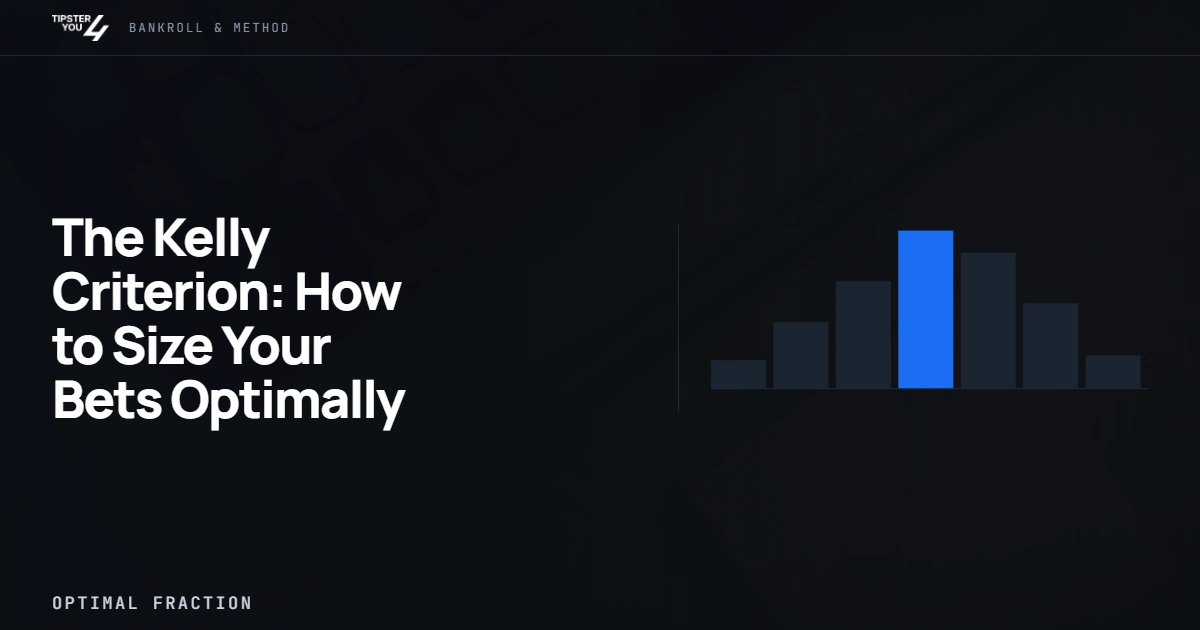
The formula was published in 1956 by John L. Kelly Jr., a researcher at Bell Labs, in a paper on information theory. His goal: find the fraction of capital to risk on each wager in order to maximise the geometric growth of that capital over the long run.
In other words, Kelly is not trying to maximise the profit of a single bet. It looks for the stake that, repeated hundreds of times, grows your bankroll as fast as possible without ever exposing it to ruin. That is exactly the sports bettor's problem.
The Kelly Formula
The classic version reads:
f = (b × p − q) ÷ b
where:
- f is the fraction of bankroll to stake;
- b is the net profit per unit staked, i.e.
odds − 1; - p is your estimated probability that the bet wins;
- q is the probability of losing, i.e.
1 − p.
An equivalent form, often handier when you think directly in decimal odds:
f = (p × odds − 1) ÷ (odds − 1)
You will recognise the numerator: p × odds − 1 is precisely the expected value of the bet.
Kelly is therefore a natural extension of the value bet: the
higher the EV, the higher the recommended fraction.
A Complete Worked Example
Take a bet at odds of 2.50 that your analysis gives a 50 % chance of winning.
b = 2.50 − 1 = 1.5p = 0.50,q = 0.50f = (1.5 × 0.50 − 0.50) ÷ 1.5 = (0.75 − 0.50) ÷ 1.5 = 0.25 ÷ 1.5 ≈ 0.167
Kelly recommends staking 16.7 % of your bankroll. With a €1,000 bankroll, that is a stake of €167.
Check with the odds form: (0.50 × 2.50 − 1) ÷ (2.50 − 1) = 0.25 ÷ 1.5 ≈ 16.7 %. Same result.
Why "Full Kelly" Is Too Aggressive
€167 on a single bet with a 50 % hit rate sounds huge? It should. Full Kelly has two major flaws in practice:
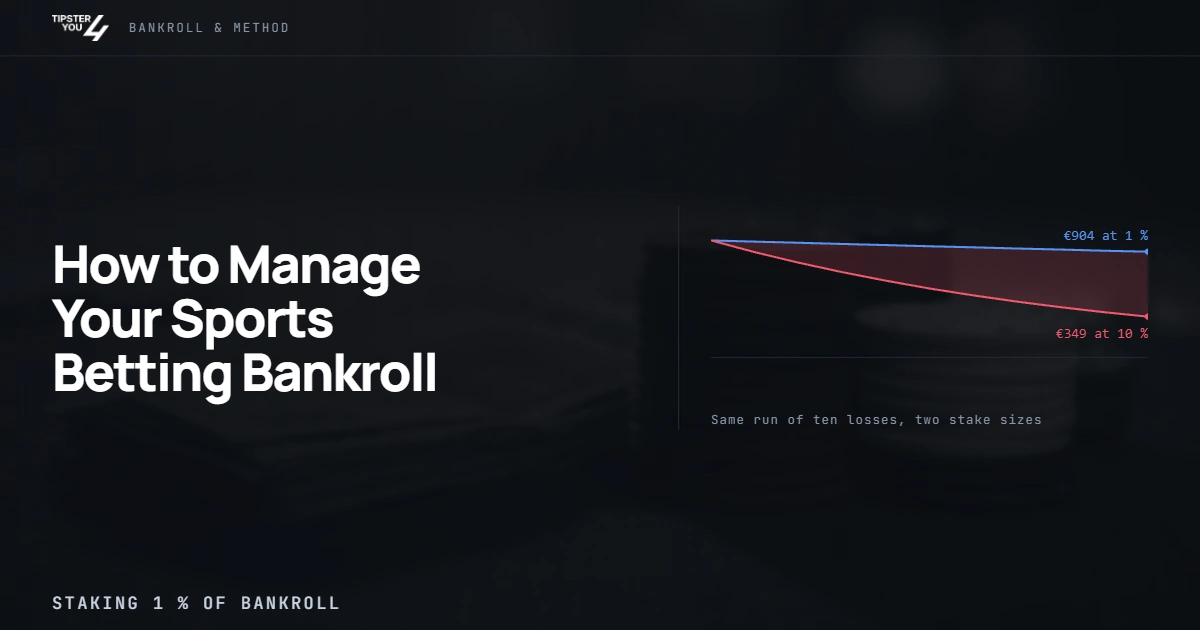
1. Enormous variance. Mathematically optimal over infinity, full Kelly accepts brutal losing runs. At 16.7 % per bet, three consecutive losses — perfectly ordinary at 50 % — wipe out more than 40 % of your bankroll. Few bettors can stomach that.
2. Total dependence on your estimate of p. The formula assumes your probability is exact. But you are estimating it. If you think 50 % when the true probability is 42 %, full Kelly makes you over-stake systematically — and over-staking is the fastest road to ruin, even with value on your side.
That is why nobody serious uses full Kelly.
Fractional Kelly: Half-Kelly, Quarter-Kelly
The standard fix is to apply only a fraction of the Kelly result:
- Half-Kelly: you stake half of the calculated fraction.
- Quarter-Kelly: you stake a quarter.
You keep most of the long-run growth while cutting the variance dramatically. Here is what it looks like on a €1,000 bankroll:
| Bet | Odds | Estimated prob. | Full Kelly | Half-Kelly | Quarter-Kelly |
|---|---|---|---|---|---|
| A | 2.50 | 50 % | 16.7 % → €167 | 8.3 % → €83 | 4.2 % → €42 |
| B | 1.80 | 60 % | 10.0 % → €100 | 5.0 % → €50 | 2.5 % → €25 |
| C | 3.50 | 32 % | 4.8 % → €48 | 2.4 % → €24 | 1.2 % → €12 |
| D | 2.10 | 50 % | 4.5 % → €45 | 2.3 % → €23 | 1.1 % → €11 |
| E | 1.50 | 62 % | −14 % → €0 | €0 | €0 |
Working: B → (0.60 × 1.80 − 1) ÷ 0.80 = 0.08 ÷ 0.80 = 10 %; C → (0.32 × 3.50 − 1) ÷ 2.50 = 0.12 ÷ 2.50 = 4.8 %; D → (0.50 × 2.10 − 1) ÷ 1.10 = 0.05 ÷ 1.10 ≈ 4.5 %.
Look at bet E: 0.62 × 1.50 − 1 = −0.07, the result is negative. Kelly is simply telling
you not to bet. That is consistent with EV: no value, no stake.
Kelly and the 1–3 % Unit Rule
Look at the quarter-Kelly column: 4.2 %, 2.5 %, 1.2 %, 1.1 %. You get almost exactly the well-known 1 to 3 % unit rule taught in every bankroll management guide.
That is no coincidence: the empirical rule is an approximation of fractional Kelly for bets with moderate value, which is the reality of a disciplined bettor. What Kelly adds is modulation: a stronger edge justifies a bigger unit, a weaker edge a smaller one. You keep the caution of the unit rule with the precision of the formula.
Limits You Need to Know
- Everything rests on p. Kelly does not create value, it sizes it. A biased estimate gives a biased stake. Calibrate your probabilities against your real track record (your ROI and yield will quickly tell you if you are overrating yourself).
- Simultaneous bets. The formula is built for sequential bets. If you place 5 bets on the same evening, each sized on the full bankroll, your real exposure is the sum of the fractions — possibly far too high. Reduce the fraction further or size on the remaining bankroll.
- Accumulators. On a parlay, p is the product of several uncertain estimates; the error multiplies. Quarter-Kelly at most.
The Most Common Mistakes
1. Using full Kelly. As we saw: unbearable variance and immediate punishment for any estimation error. Half-Kelly for experienced, well-calibrated bettors; quarter-Kelly for the vast majority.
2. Recalculating on today's bankroll while on tilt. Kelly is computed on your actual bankroll, not on what is left after a bad night you want to "win back". If you are chasing losses, you are no longer in a Kelly mindset.
3. Applying Kelly to gut-feel estimates. "I feel it at 70 %" is not a probability. If you have no method for estimating p, Kelly will give you precise stakes… built on false foundations. Start with a fixed unit rule, and move to Kelly once your track record proves your estimates hold up.
Kelly Criterion Checklist
- I have an estimated probability from analysis, not from intuition.
- I calculated
f = (p × odds − 1) ÷ (odds − 1). - If f is zero or negative, I do not bet.
- I apply a fraction (half or quarter), never full Kelly.
- I size on my reference bankroll, not on today's mood.
- If I have several open bets, I reduced the fraction accordingly.
- My final stake stays in a zone I can lose without consequence.
The Kelly criterion is no magic wand: it is a numerical guardrail that forces you to tie every stake to the real value of the bet. Used in fractional form, it grows your bankroll faster than flat stakes while keeping it far from the red zone. And remember: sports betting should remain a hobby — never stake money you need.
Tipsters in the Tipster4You ranking show a verified, bet-by-bet track record: the best ground for calibrating your own probabilities before running them through Kelly.