You can have the sharpest analysis around, a bankroll plan that looks perfect on paper and a good eye for value… and still lose everything in a single evening. Not because of a bad pick — because of you. Over the long run, psychology weighs more than analysis: it decides whether you stick to your plan or throw it out at the first bad beat. This article explains what tilt is, which cognitive biases trap you without you noticing, and above all how to protect yourself with concrete rules.
Why Your Head Matters More Than Your Analysis
A bettor with an average strategy but iron discipline almost always finishes ahead of a brilliant but impulsive one. The reason is mechanical: analysis determines the expected value of your bets, but discipline determines whether you stay in the game long enough for that expectation to materialise.
Three losses in a row ruin nobody. Three losses followed by two "get it back" bets at five times your usual stake do.
Tilt: Definition and Triggers
The word comes from poker: a player "on tilt" has lost their composure and makes decisions driven by emotion rather than logic. In sports betting it is exactly the same thing.
Classic triggers:
- A bad beat: your bet was winning until the 94th minute, then a dubious penalty flips it.
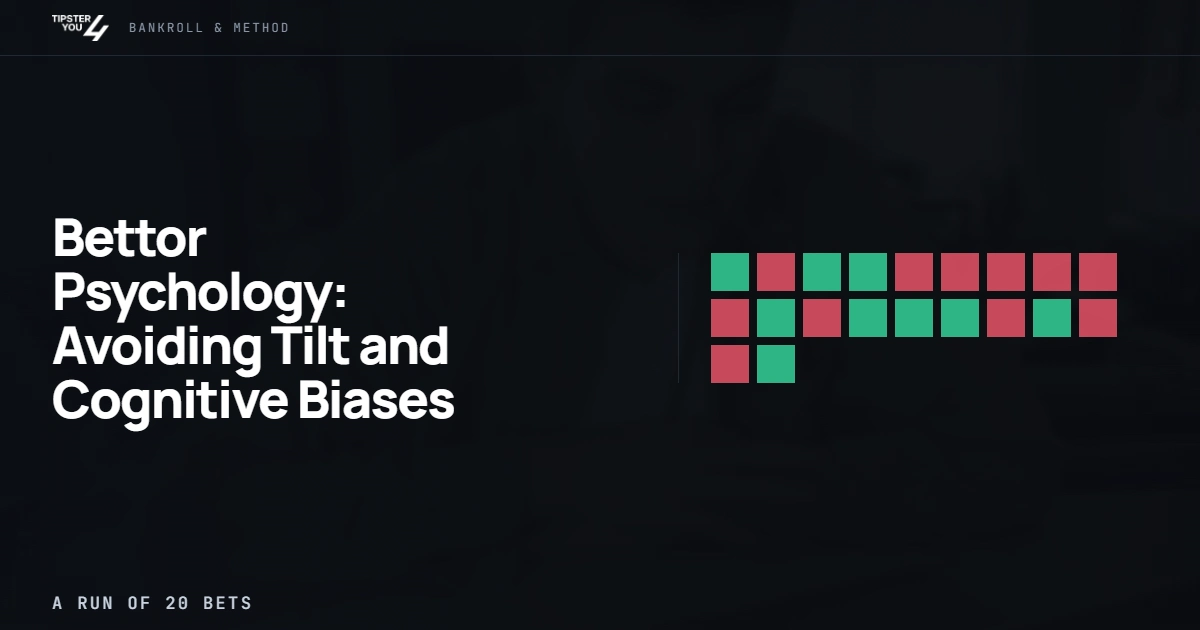
- A losing streak — even a statistically normal one — that makes you feel "this can't go on".
- A missed bet (the odds dropped before you confirmed, or a match you wanted to play went by without you).
- Fatigue, or simply a bad day outside of betting.
Symptoms:
- Your stakes grow with no analytical reason.
- You place off-plan bets: a sport you don't follow, a match kicking off in 3 minutes, an 8-leg accumulator.
- You chain live bets compulsively, just to "stay in the action".
- You feel urgency: it has to be recovered tonight, not next week.
A Worked Example: The Tilt Spiral
Take a disciplined bettor: bankroll of €1,000, unit set at 2%, i.e. €20 per bet.
Rough evening: 3 losing bets → −€60. Bankroll: €940. Perfectly normal — a run of 3 losses shows up on average every 10 to 15 bets at odds of 2.00.
Scenario A — the disciplined bettor: closes the app. Bankroll €940. Tomorrow they bet €20 again (or €18.80 if they recalculate the unit). Nothing in the plan has changed.
Scenario B — the bettor on tilt: wants to "get it back". Stakes €100 (5 units) on a match they haven't analysed, odds 1.80. Loses. Bankroll €840. Doubles up: €200 on a "safe" live bet at 1.50. Loses. Bankroll €640.
| Bankroll after 3 losses | "Get it back" bets | Final bankroll | Total loss | |
|---|---|---|---|---|
| Disciplined | €940 | none | €940 | −6% |
| On tilt | €940 | €100 then €200 | €640 | −36% |
In two impulsive bets, bettor B lost six times more than the three analysed bets that annoyed them in the first place. And they now need a +56% return on €640 to get back to €1,000, versus +6.4% for bettor A.
Tilt doesn't cost you a bet. It costs you weeks of work.
The 6 Cognitive Biases That Trap Bettors
Tilt is an emotional state. Cognitive biases are systematic reasoning errors — you can fall for them while perfectly calm.
| Bias | What it is | Effect on your bets | Countermeasure |
|---|---|---|---|
| Confirmation bias | You look for information that supports your idea and ignore the rest | You always "find" reasons for the bet you already wanted to place | Write down the arguments against first, then decide |
| Gambler's fallacy | Believing a streak influences the next outcome | "The over has hit 5 times, the under is due" | Each match is independent; reason in probabilities, not streaks |
| Loss aversion / chasing | A loss hurts more than a win feels good | You raise stakes to "erase" the loss as fast as possible | Fixed stake decided before the session, stop-loss |
| Overconfidence | After a winning run you feel infallible | Inflated stakes, bets outside your area of competence | Keep the same unit on a hot streak as on a cold one |
| Recency bias | You overweight the last few matches | A team that just won 4-0 looks unbeatable | Look at 10–15 matches, not 1; use stats, not memories |
| Fan bias | You underestimate your own team's weaknesses | You bet on your club out of loyalty, not value | Never bet on (or against) the team you support |
None of these biases disappear just because you know about them. But knowing them lets you build mechanical guardrails — which is what the next section is about.
Warning Signs: Are You on Tilt?
Answer honestly:
- Are you about to stake more than your usual unit?
- Was this bet planned before the evening started?
- Did you analyse this match, or do you just "feel it"?
- Did you lose a bet less than 30 minutes ago?
- Are you telling yourself "just this one and then I stop"?
Two or more "yes" answers: you are probably on tilt. Close the app. The match will still be there tomorrow — and another one the day after.
Anti-Tilt Protocol: 6 Concrete Rules
Discipline is not a matter of willpower. It is a matter of rules set when calm and applied when heated.
- Daily stop-loss. Example: −3 units on the day → you stop, no exceptions. With a €20 unit, that's −€60. You pick this threshold on a Sunday morning, not at 10:45 pm on a Saturday.
- 24-hour break after a bad beat. An unfair loss doesn't call for revenge, it calls for distance.
- Betting journal with the reason written before the stake. One line per bet: match, market, odds, stake, and why. If you can't write the reason in one sentence, you don't have one.
- Stakes fixed in advance. Your unit is defined by your bankroll, not your mood. For the 1–3% rule, revisit our guide on bankroll management.
- No bets on the team you support. Neither for nor against. You are not objective, and you never will be.
- Don't watch the score continuously. Following a bet minute by minute feeds emotion, not analysis. Check the result at the end.
Outsourcing Discipline: The Role of a Tipster
Following a disciplined tipster won't make you rich by magic — but it can help you take the decision out of your own hands at the moment you are least reliable. A good tipster publishes a stake in units, a market, odds, and a verified track record. You apply it; you don't reinterpret it.
This doesn't eliminate tilt (you can still double the suggested stake), but it removes one of its main sources: improvisation. Provided you pick someone whose ROI and yield hold up over hundreds of bets, not one good week.
The Most Common Mistakes
1. Believing it only happens to other people. Everyone tilts. The difference between bettors who last and the rest is the presence of a guardrail.
2. Raising your limits "just for tonight". A limit you can change in 10 seconds is not a limit.
3. Betting to take your mind off things. Bad day at work, tiredness, boredom: these are the worst moments to stake. Betting is not an outlet.
4. Confusing a losing streak with a broken strategy. A run of 5 losses at odds of 2.00 is not a signal that your method is broken. Judge your method over 200 bets, not 5. Almost all the classic beginner mistakes revolve around this confusion.
Anti-Tilt Checklist
- My unit and daily stop-loss are written down somewhere, decided when calm.
- Every bet has a written reason in my journal before I confirm it.
- I haven't lost a bet in the last 30 minutes.
- This bet was planned before the session.
- I am not betting on the team I support.
- My stake is identical to yesterday's, hot streak or cold streak.
- If I've hit my stop-loss, I've closed the app.
Responsible Gambling
If you often recognise yourself in the tilt warning signs, use the tools licensed operators provide: deposit limits, stake limits, and temporary or permanent self-exclusion. And if betting is becoming a source of stress or debt, reach out to self-exclusion tools and local helplines — talking about it is not a failure, it's a bankroll decision like any other.
To delegate the analysis and keep your head for discipline, check the tipster ranking — verified track records, stakes in units, filters by sport and return.